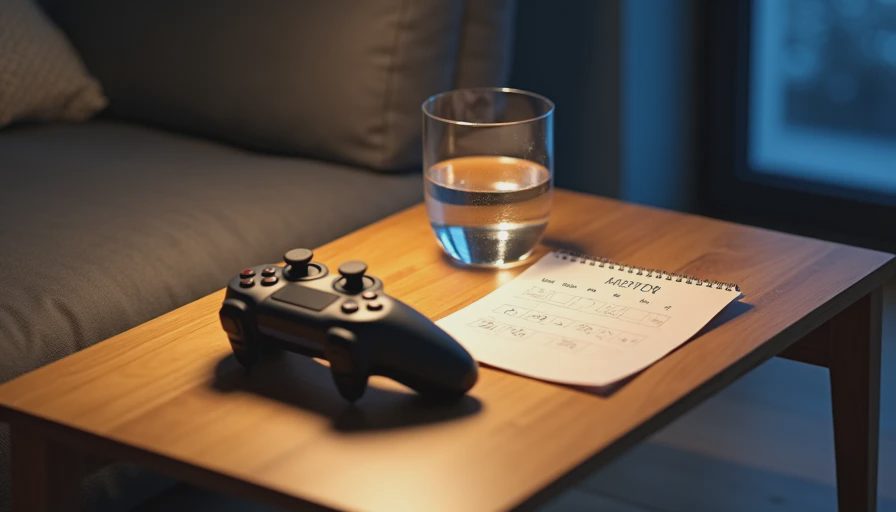
The Week That Erases Your Momentum
A good game should earn your weekend. It should also survive the week that deletes your momentum entirely.
I call it the Dad Test because that is the life I am actually living. A normal week can include late meetings, a kid home sick, a school event that runs long, and a Saturday that turns into errands and grocery runs. By the time I sit back down with a controller, five or seven or even ten days may have passed since the last session.
Some games handle that gap with grace. You load the save, the objectives are still clear, the controls feel familiar within a minute, and you are back inside the experience. Other games punish the gap. You stare at the screen trying to remember what you were doing, why it mattered, and how the systems worked. The first fifteen minutes become a re-orientation tax that eats a large share of the short session you finally have.
That difference has become one of the strongest filters I use.
Why the Test Matters More Than Raw Quality
A game can be well-made, critically liked, and still fail the Dad Test. High production values do not automatically translate into easy re-entry. Complex control schemes, deeply nested menus, temporary on-screen prompts that disappear forever, or quest logs that assume continuous attention all create friction after a break.
I have quit more than one highly rated title not because it was bad, but because every return felt like starting a half-step behind. Over time that friction compounds. The game slowly trains you to stop coming back.
The opposite experience is quietly powerful. When a game lets you step away for a chaotic week and still feels like an old friend when you return, it earns a permanent place in the rotation. Those are the titles I actually finish.
What Passing the Dad Test Looks Like

Games that survive my real schedule share a few practical traits.
Clear, persistent objectives. When you load in, you immediately know the next sensible action. You do not need to dig through journals or reconstruct the plot from memory.
Controls that return quickly. Muscle memory should reassert itself inside the first minute. If the input scheme is so dense that a week away resets your competence, the game is asking for a different kind of player.
A low-stakes way to regain orientation. The best examples give you a short, safe activity you can do while the bigger systems come back into focus—an easy side task, a small crafting loop, or a familiar hub area.
No punishment for absence. Resource decay, missed limited-time events that gate progress, or story moments that become incoherent if you forget a single conversation all fail the test.
When these pieces are present, a chaotic week feels like a pause. When they are missing, a chaotic week feels like a soft reset with extra resentment.
A Personal Calibration Method
I no longer trust the first two polished sessions alone. After I have a basic feel for a new release, I deliberately let several days pass. Then I sit down and pay close attention to the opening minutes of the return session.
If I am back in the flow quickly and the game feels familiar, it stays. If I spend those minutes confused, menu-diving, or faintly irritated, I treat that friction as real data. Most of the time it predicts how the rest of the relationship will go.
This method has saved me from several long, low-grade commitments that would have consumed evenings without ever feeling satisfying.
How to Spot the Risk Before You Buy
Early gameplay footage and first-week player comments often reveal the problem if you know what to look for.
Watch how much critical information is delivered through temporary prompts rather than persistent UI. Games that rely on one-time instructions tend to punish breaks.
Listen for phrases like “I had to relearn the controls after a few days off.” That complaint appears more often than marketing would suggest.
Check whether the quest log or journal is robust enough to stand alone after time away. A good log is not flavor. It is infrastructure for interrupted players.
Notice if the core loop can be partially completed in a short session and resumed cleanly. Games built around long, unbroken concentration sequences are higher risk for anyone whose free time arrives in fragments.
None of these signals is perfect. Together they give a clearer picture than the aggregate score.
Protecting the Hours That Actually Exist
I still get drawn to games that demand more continuous attention than my life reliably supplies. When that happens I now make a cleaner choice. Either I wait for a lighter stretch of calendar before starting, or I pass and keep the evenings I do have for something that fits the schedule I actually live.
There is no failure in the second option. There is only the practical recognition that chaotic weeks are normal and that a game which cannot handle them is designed for a different player than the one holding the controller.
The best games for busy parents and working adults are not always the ones that dominate the conversation. They are the ones that let life interrupt them and still feel welcoming when you return.
That quiet reliability is rarer than it should be. When you find it, the game has already begun earning every weekend you decide to give it.
A good game should earn your weekend. The ones that pass the Dad Test earn the weeks in between as well.





No comments yet — grab the first one.