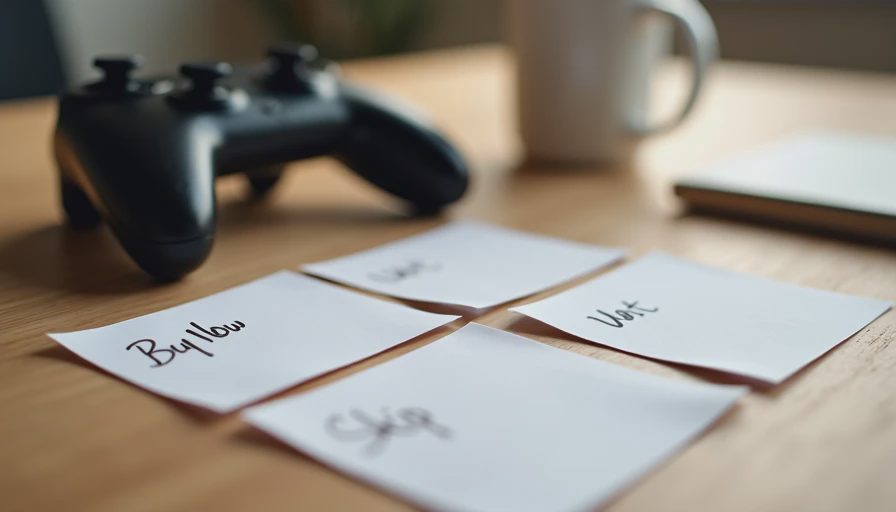
The Decision Does Not Have to Be Emotional
Every new release arrives with the same quiet pressure. Buy it now and be part of the conversation, or wait and risk feeling behind. I used to resolve that pressure by buying more often than I should have. The result was a library full of games that were only “pretty good” and a growing sense that my money and evenings were being spent on autopilot.
I needed a simpler way to decide. Not a spreadsheet. Not a rigid set of rules. Just a clear framework I could run through in a few minutes before the store page won the argument.
A good game should earn your weekend. At the point of purchase it should also earn the specific price and timing you are offering it.
The Three Options Are Enough
Most buying decisions collapse into three practical choices:
Buy now at full price.
Wait for a meaningful sale.
Skip it.
Everything else is variation. Pre-ordering, buying the deluxe edition, or picking it up during a minor discount are just different versions of these three paths. Keeping the options small makes the decision clearer.
Filter One: Session Fit and Returnability
Before price even enters the conversation, I ask whether the game matches the way I actually play.
Can I make meaningful progress in forty-five to sixty minutes? Does it forgive a week away without forcing me to relearn everything? Are there natural stopping points, or does it punish interruption?
If the early consensus or my own first-hour experience suggests the game needs long, unbroken sessions or constant attention, it almost never earns a “buy now.” Those games can still be good. They simply move into the “wait” or “skip” column for my life. Paying full price for something that will sit unfinished is one of the more reliable ways to waste money.
Filter Two: What Full Price Is Actually Buying
When a game clears the session-fit bar, I look at what the launch price is purchasing.
Am I paying for a complete experience that already feels finished, or am I paying to be early? Is the core loop satisfying on day one, or does the game still feel like it is waiting for patches, balance updates, or additional content to become itself?
I also check whether the experience is distinctive enough that waiting would feel like a real loss. Some games offer a tone, a world, or a mechanical idea that is hard to get elsewhere. Others are competent executions of familiar ideas. Competence alone rarely justifies seventy dollars on day one for me. Distinctiveness plus solid session fit can.
Filter Three: The Six-Month Test

The most useful question I ask is also the simplest: If this game never dropped below full price, would I still be glad I bought it six months from now?
If the honest answer is yes, “buy now” becomes reasonable. If the answer is “I’d be just as happy paying forty or fifty dollars later,” then waiting is the clearer choice. If the answer is “I probably wouldn’t miss it,” the game moves to skip.
This question cuts through a lot of temporary excitement. Launch hype fades. The receipt does not.
How the Framework Runs in Practice
When a new game I am interested in launches, I give it a short, deliberate check:
Does it fit short and irregular sessions?
Is the launch version already delivering a complete, distinctive experience?
Would I still be happy with a full-price purchase half a year from now?
Three yes answers → buy now is on the table.
Two yes answers → wait for a sale is usually the smart move.
One or zero → skip or revisit much later.
I do not need perfect information. Early impressions, a couple of trusted long-form takes, and my own sense of the trailer-versus-gameplay gap are usually enough to run the filters. If the signals are mixed, defaulting to “wait” has saved me more money and more regret than it has cost me in missed moments.
What About FOMO and the Conversation?
There is a real social cost to waiting. Some games are more fun when the wider conversation is active. I do not pretend that cost is zero. I simply weigh it against the actual hours and dollars at stake. In most cases the conversation moves on faster than the price drops. Being a week or a month behind rarely ruins the experience. Paying full price for a game that did not earn it leaves a longer mark.
How This Will Shape the Posts Ahead
Every Full Price or Wait piece will apply some version of this framework. I will not claim it is the only way to decide. I will only claim it is a clearer way than buying on vibes and justifying it afterward.
Some games will clear all three filters and earn the recommendation to buy at launch. Others will be easy to praise while still being better purchases at a discount. A few will be the kind of release that is more honest to skip. The goal is to make those distinctions visible so readers can apply their own version of the same logic.
If you have ever stood on a store page on launch day feeling both interested and vaguely reluctant, you already understand the tension. This framework exists to turn that tension into a decision you can defend to yourself later—when the hype is gone and only the time and money remain.




No comments yet — grab the first one.